The Left and Chile
During the 1970s Chile went through some dark days, it lost it's democracy, prosperity and descended into violence. This lead to a US backed military coup installing Augusto Pinochet, a military strongman as dictator from 1973 till 1990 when the country was returned to democracy. Pinochet's regime has been a left-right battleground for a long while now due to Chile's economy: Whilst Pinochet was murdering and torturing those he disagreed with the Chilean economy actually boomed. The boom has been primarily attributed to the alumni of the University of Chicago and their belief in that establishment's school of economics(aka Freshwater economics) whose patriarch Milton Friedman had significant involvement with the Chilean reforms. So the argument is like this, the right say; look Chile is rich and successful because of the reforms of the Pinochet era. The left say that the rights ideas are so terrible and unpopular that the only way they can get applied is through a desperate and despicable dictator.

Pinochet, the Fashionista .

Friedman in equally dapper attire
Now as always, context is crucial. Pinochet didn't just dawn the aviators and in a statement of destiny utter, at no one in particular, 'lets do this', his eyes set on the Authoritarian of the year award. As was stated at the beginning of this blog, Chile lost its' wealth, peace and democracy in the 70s, but none of those things can be solely attributed to Pinochet, he decayed the second, utterly ruined the 3rd but returned the first. The last democratically elected president, Salvador Allende was the main reason the coup occurred. Allende was certainly no advocate of peace, no angel despite modern attempts by the left to touch him up as a working class hero who was the first victim of the corporatist Pinochet. Allende was the typical ideologue that believes so strongly in his own self-righteousness that secular notions of morality get thrown out the window, the end justify the means, and Allende knows what means makes what ends: he can adopt a less rigid form of morality to secure that, come what may, the workers paradise will be built. Of course it was a disaster and when Allende was finished playing his game of bread and circuses, the shops' shelves were empty, inflation was super high, everyone was on strike, militants were fighting on the street and no one had a job. Allende was engaging in illegal actions, in defiance of the legislative and judicial branches whilst arming the communists and disarming the more right wing militia. Pinochet dawns the aviators and stages his coup. Upon gaining power he immediately begins murdering and torturing Allende's former supporters and other left wing activists that he viewed as a threat.

Allende and his man crush
Under Pinochet's Junta, finance ministers and the like were almost exclusively of the Chicago variety. The economy very quickly recovered and then had a bad crash due to a bubble created by the currency pegging with the dollar, an idea opposed by Milton Friedman. Regardless, the Economic liberalizations continued, tearing away of trade barriers and putting state run industries back into the private sector. Much like Britain and the United states, the reforms that took place in the late 70s and throughout the 80s, whilst demonstrating success in their own periods really came into their own in the 90s(Britain had an average GDP growth of 2.6% in the 90s, France and Germany that had ducked these reforms grew and as a result grew less than % slower). During the 1990s the Chilean economy was the best performing in Latin America, one of the best in the world, this trend continued into the naughties (uugggghhhhh, can't wait to get to the 20s, naughties and the tweenies, pass the sickbag). In 1990 Pinochet returned Chile to a democracy. This is where the obsession part of the title comes in, the slow and gradual return to democracy after a complete breakdown leading to a coup was not a Chilean exception, in the 1960-80s South America it was common, in fact that exact phrase 'slow, gradual and safe return to democracy' was used by the Brazilian dictator Ernesto Geisel.
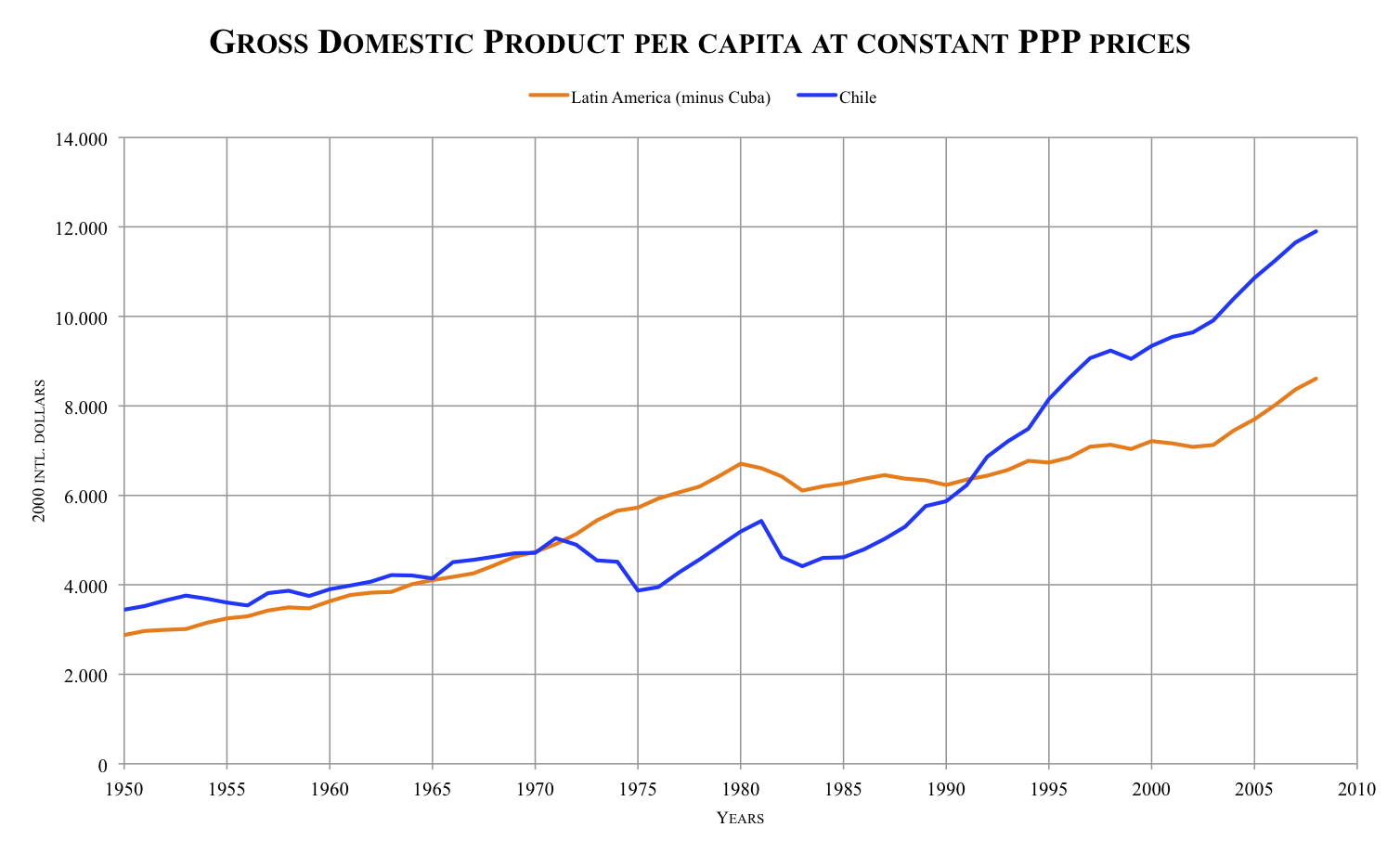
As you can see, Allende comes in and everything goes to hell between 1970-73, sharp recovery and then a currency crisis in 1982, after more privatizations beginning in 1985 a long, strong boom takes off.

The Brazilian comparison is definitely worth a look, Geisel and Pinochet are very similar, except that Geisel's coup and return to democracy was one decade earlier, 64 and 79 respectively(ok one out on either end), the resemblance is very remarkable. The 64 coup of Brazil was led by the military and toppled a left wing government, the junta tortured and murdered lefties, the junta gave a China-esque economic performance, averaged around 8% growth, over 10 pre 1973. The major difference though is that Brazil is a much much bigger and more significant Geo-political player than Chile, populations about 195mill to 17mill, more than 10 to 1, yet I would bet in the US and the rest of the Anglo-sphere the people that know what happened in Chile outnumber those that know what happened in Brazil 10 to 1.
So what is the Script? why is Chile the lefts' favorite whipping boy after US and Izzy? Well I will explain in the socratic style of taking a stroll through the scenic route. I was having a discussion about Thatcher with a socialist, very easy. Thatcher reversed a trend 110 years old of British relative economic decline(in real gdp per capita, relative to US, France and Germany 1870-1980). A few half-truths illuminated later when all common and plausible arguments are exhausted a 'thank you for this enlightening and lively mutual inquiry' is never forthcoming. Instead the ego, compelled by a stiffening spine and the sense that its fortress is falling lets loose the fallacies of war, financed with credit secured on a mortgaged dignity. He doesn't pull punches, out comes the association fallacy "SHE WAS FRIENDS WITH PINOCHET!1!11!". Oh boy here we go. Instead of telling him that Hitler was a vegetarian like a good critical thinker I just made a utilitarian argument for the Pinochet junta; that the Junta was a net benefit to Chile, Pinochet personally wasn't however.
"In the particular is contained the universal." said the great author James Joyce. The particular in this case is Maggie's association with Pinochet, the universal is the free enterprise systems association with totalitarianism. It seems the left have a bigger brush than we do(liberal media, u kno its tru) because after a century of watching the commie kill count rise to the 100s of millions the right are still the dangerous ones. But then it probably balances out when you consider the actions of that far right government the National SOCIALISTS(This isn't a cheap point, I will defend it and plan to write on it). I found it surprising, even before I became a convert to his ideas, that Milton Friedman was often challenged for giving economic counsel to Pinochet's government: If dictator A forces on the people the much despised X, Y and Z and then D convinces him to stop Z to the benefit of the people, is D a bad person for collaborating with A, or a good person for getting rid of Z? The answer is obvious, but if you have got an axe to grind, a knack for sophistry and an audience who are oblivious to the real world/counter arguments then you can get that audience to believe anything.
The Chilean shelling
I am going to question some Representative pieces and provide counter arguments for them. The first seeks to rubbish the Chilean miracle and a piece that attempts to use the Chilean Juntas economic policy as a RPG against free-marketeers and is at the forefront of this association fallacy.
The fair and balanced economic analysis of Chile.
- Income inequality on Page 7
Lets see how the picture changes when you replace the kids from the rich neighborhood to the kids from Chile's neighborhood. So get rid of Denmark, Finland, S.K, France, UK, US and put in Brazil, Columbia, Mexico, Belize, Bolivia and Guatemala. Keep the Argies and Jamaica. Get rid of Namibia.When measured for income inequality in Chile, comparing it not to first world European countries but instead to other South American states we get:
- Argentina
- Jamaica
- Mexico
- Chile
- Belize
- Brazil
- Guatemala
- Columbia
- Bolivia
4th out of 9 isn't bad, especially when you consider how much richer and faster growing chile is relative to the rest.So the big spiel following their proof that Denmark is more equal than Chile(investigative journalism at its finest) about how Chile likes to trample workers beneath the boots of shade wearing, cigar crunching capitalists is hyperbole garbage.
- Pg 8 "Neo-liberal policies lead to very little growth"
Pg 9 "Chile’s growth relies heavily on export of limited natural resources at unsustainable rates, while its manufacturing sector continues to contract"
Right now it is where the money is. They are mining copper heavily because it went through a massive price boom
not because their neo-liberal model makes them bad manufacturers. They
are still a developing country, they will mine and sell copper, invest in chile, educate themselves and as their productivity increases they will diversify. Also because Chile's manufacturing peaked under Allende doesn't mean that manufacturing was the right thing for them to do, given how fast Allende crashed the economy we can only speculate as to what Allende's commissars had them manufacturing.
 Why would Chileans stop mining copper when it quadruples in price?

Naomi Klein's shock doctrine
Naomi Klein's Shock doctrine is basically the theory that the right advances its policies under times of crises because at no other time will people tolerate that crap. The first thing to appreciate about Ms Klein is that she is willing to create an independent narrative no matter how much reality disagrees. If you can just grab your handy all protecting tinfoil hat and stick it up on top we will take a tour through Kleinland.

Naomi lobbying to give the soviet union another chance
In the immediate post war period the powerful wizards of capitalism met up at the last bastion of exploitation left in the world, Switzerland. Here they wept and sobbed at the passing of an era, they celebrated the death of Keynes but confounded the workers he had liberated. Among them there was one who, while ideologically aligned with his rather more elderly peers, felt their reservations about manipulating the masses to be a problem. This young up'n comers name was Milton Friedman, his friends and enemies alike called him Lucifer. Milton went home determined to get the world back to the good old days of privilege and prejudice, however this required patience, the world had just drank the kool-aid and it liked what it saw. To occupy his time whilst accumulating respectability, authority and capital he done just about the only work he could stomach; he wrote books about money.
For 20 years Milton molded his rhetoric, ironing out his ideology, embellishing his disciples in the dark arts. Now he was prepared, his tolerance for Keynesian counter recessionary measures and welfare to help the impoverished urban youth would be tested no more, "Purge the weak!" became his chant. Milton, through his subversive agents got the US government to embargo Chile, fearing the emergence of a workers utopia. Poor little chile, that dark corner of the earth with its long suffering natives would be Milton's first lab rat. GDP increased, government shrunk, Chile imports American weapons and hamburgers, its income inequality increased, SUCCESS! Emboldened Milton goes around the world launching small, but devastating in their locales, attacks on workers' freedoms. He finally had gathered enough strength to topple Britain and the United states through his agents Thatcher and Reagan. The rest was history.
"Naomi Klein's Shock doctrine is basically the theory that the right advances its' policies under times of crises because at no other time will people tolerate that crap."
- All governments have political capital, the more secure they feel in their position they more they will advance their agenda. I am imagine that the fact that the British labour party and Truman in the United States both pushed through massive socialists policies in the immediate post war situation is not considered on the left.
- Margaret Thatcher started going heavy on the monetarist agenda in 1981 during the battle for the budget. She won the Falklands war in 82 which boosted her popularity to win a landslide in 83, she decided to speed up the agenda due to her massive majority, she privatized state run businesses, cut taxes and ended subsidies. After 4 years in Thatcher's hell the people were so confused and bedazzled that they accidentally voted for her, unwittingly giving her another landslide, same thing 5 years later.
- When a country starts going seriously wrong then the government tends to slam on the brake, turn around and go as fast as possible in the opposite direction. The fact that crises are moments of great change is really not that suprising, a crisis is a do or die .E.g. In 1984 New Zealand elects a labour(social democratic) government who discover that the country is bordering on bankruptcy, probably because the government had taken complete control of wages and prices in 82 and was rapidly running the country into the ground.

No comments:
Post a Comment